
Views: 0 Author: Site Editor Publish Time: 2026-09-02 Origin: Site


Upgrading industrial instrumentation often forces a difficult choice. You must decide between legacy reliability and high-frequency precision. Plant managers constantly seek better accuracy and minimal maintenance for their operations. In the realm of non-contact level measurement, the debate heavily centers on frequency. While 80GHz technology is marketed as the modern standard, it is not a universal fix for every facility. Selecting the wrong frequency can cause false readings and costly downtime.
Every industrial vessel presents unique physical and environmental challenges. We will explore beam angles, tank geometries, and media properties to clarify this complex issue. This guide bypasses marketing claims to provide an engineering-focused breakdown. You will learn exactly when to upgrade to an 80GHz radar level meter. You will also discover when a 26GHz system remains the most practical choice for your specific facility.
Beam Angle dictates performance: 80GHz meters offer a much narrower beam (typically 3°–8°), making them superior for avoiding internal tank obstacles compared to the wider beam (10°–20°) of 26GHz meters.
Nozzle constraints matter: 80GHz antennas fit into significantly smaller mounting nozzles without signal degradation.
Cost vs. Complexity: 26GHz remains a highly reliable, cost-effective choice for standard bulk storage and wide tanks with minimal internal interference.
Media factors: Both require evaluating the dielectric constant of the media, though 80GHz handles heavy condensation and dust more effectively.
To understand radar performance, we must look at the physics of frequency. There is a direct inverse relationship between frequency and wavelength. A higher frequency results in a shorter wavelength. This shorter wavelength allows the device to emit a much tighter, more focused signal.
When you compare these technologies, beam angle is the most critical differentiator. An 80GHz meter typically operates with a narrow 3° to 8° beam angle. Conversely, a 26GHz radar level meter emits a wider signal, usually spreading between 10° and 20°. This fundamental difference drastically changes how the radar interacts with its environment.
The practical implication of this beam spread is significant. In a deep vessel, a 20° beam widens dramatically as it travels downward. It easily bounces off tank walls, agitator blades, or heating coils. These unintended reflections create false echoes. A narrow 3° beam bypasses these internal structures completely. It travels straight down to the media surface, returning a clean and reliable signal.
Radar Level Meter Frequency Comparison
Feature | 26GHz Radar | 80GHz Radar |
|---|---|---|
Beam Angle | 10° – 20° | 3° – 8° |
Wavelength | Longer (~11mm) | Shorter (~4mm) |
Internal Obstacle Avoidance | Poor to Moderate | Excellent |
Antenna Size Requirement | Larger (typically 3"+) | Smaller (can fit 1.5") |
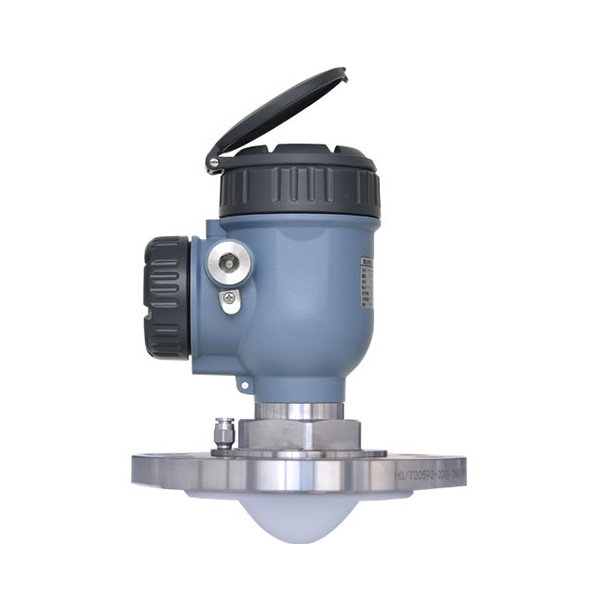
Upgrading to higher frequencies makes sense under specific engineering constraints. Facility standardization should rely on the geometric and atmospheric realities of your process vessels. Here is when 80GHz technology truly excels.
Modern industrial tanks often contain complex internal structures. You might find baffles, aggressive agitators, or extensive heating coils inside. Tall, narrow silos also present unique challenges. A standard radar level meter with a wide beam struggles here. The narrow beam of an 80GHz device easily threads the needle. It shoots past obstacles without generating interfering echoes.
Installation space is frequently limited in older facilities. Some vessels only offer 1.5-inch or 2-inch mounting nozzles. Large antennas physically cannot fit into these tight spaces. Furthermore, firing a wide beam through a long, narrow nozzle causes "nozzle ringing." The signal bounces against the inside of the pipe. This creates a massive blind spot at the top of the tank. 80GHz antennas are naturally smaller. They fire straight through long nozzles without signal degradation.
Vessel atmospheres can severely disrupt measurement signals. Solid silos generate heavy dust during filling. Liquid chemical tanks often suffer from dense condensation. Modern 80GHz meters utilize advanced FMCW (Frequency Modulated Continuous Wave) processing. This allows them to penetrate heavy dust clouds. They also filter out the disruptive effects of water droplets collecting on the antenna lens.
Measuring hydrocarbons, oils, or certain solvents requires careful planning. These liquids have low dielectric constants. They reflect very little radar energy back to the sensor. The superior focusing power of an 80GHz meter ensures that more signal energy reaches the liquid surface. This results in a stronger, more reliable return echo, even from challenging, non-reflective liquids.
Despite the advantages of high-frequency models, older technology is far from obsolete. Many scenarios do not require pinpoint beam focus. In these situations, a lower frequency remains the most practical and efficient choice.
Consider a wide, unobstructed bulk water tank. Beam spread is simply not a liability here. The radar wave can expand safely without hitting any internal structures. For these standard applications, a 26GHz meter provides proven, long-term reliability. It tracks the fluid level accurately without unnecessary complexity.
Not every measurement point requires top-tier precision. Utility tanks, wastewater basins, and non-critical process vessels have looser tolerance requirements. High-frequency devices often carry a premium price tag. For simple applications, utilizing a 26GHz model ensures a much faster return on investment. You get dependable performance without overpaying for unnecessary technical capabilities.
Replacing aging equipment often involves compatibility concerns. Older control systems might require specific wiring or signal protocols. Upgrading to an 80GHz unit could force you to re-engineer the mounting configuration. Using a 26GHz unit allows for an easier one-to-one replacement. You maintain your current infrastructure while restoring reliable measurement.
Calm liquids provide an ideal environment for radar signals. When you measure standard liquid levels without severe foaming or heavy vapor, 26GHz is excellent. It delivers highly stable readings for standard tank level measurement. The broader wavelength interacts smoothly with the flat liquid surface, ensuring consistent accuracy over time.
Choosing the correct radar frequency requires a structured approach. You must evaluate the physical and environmental realities of your specific application. Use the following framework to guide your engineering decisions.
Start by auditing the physical dimensions of your vessel. Assess the height-to-width ratio carefully. A tank that is 20 meters tall but only 2 meters wide demands a narrow beam. Conversely, a wide, shallow basin easily accommodates a broader signal. Next, audit your existing nozzle sizes. Check if the current infrastructure only supports small connections. If you only have 1.5-inch nozzles, 80GHz is usually mandatory. If you have 3-inch or 4-inch openings, both frequencies remain viable.
The condition of the media drastically impacts radar performance. Identify the presence of heavy foam on the liquid surface. Foam acts like a sponge for high-frequency signals. It absorbs the energy, leading to signal loss. In heavily foaming applications, lower frequencies or even guided wave radar might perform better. Additionally, evaluate extreme temperature and pressure ratings. Ensure the chosen instrument housing and antenna materials can withstand the specific demands of your process environment.
Even the best technology fails if implemented poorly. Upgrading your instrumentation comes with specific operational realities. You must understand these risks to ensure a successful deployment.
Many engineers assume 80GHz completely eliminates false echoes. This is a dangerous fallacy. While the narrow beam drastically reduces unwanted reflections, it does not prevent all of them. Welds, minor wall buildup, or slight installation angles can still create interference. Proper empty-tank mapping during commissioning remains absolutely mandatory. You must program the device to ignore static internal obstacles.
High-frequency antennas are smaller, but they are not immune to dirt. Sticky media buildup can still blind an 80GHz lens antenna. Wet dust or viscous chemicals can coat the sensor surface over time. If you work in heavy solid applications, you must plan for this. Specify the need for air-purge connections. Regularly blasting the antenna with compressed air prevents blinding and ensures continuous operation.
We must clarify a critical limitation of non-contact technologies. Neither 80GHz nor 26GHz devices are completely immune to thick, dense foam. Light foam might allow some signal penetration. However, severe foam will scatter or absorb radar waves regardless of the frequency used. If your process generates heavy foam, standard radar might fail. You must recognize when a guided wave radar becomes the safer engineering choice.
Moving from theory to procurement requires actionable steps. Follow a strict process to ensure your investment resolves your current operational pains without introducing new complications.
Define Success Criteria: Document the exact failure points of your current measurement methods. For example, write down if your "current ultrasonic fails during heavy morning condensation." Having clear criteria prevents you from buying features you do not need.
Vendor Agnostic Testing: Do not rely solely on datasheet promises. Request trial units for the most challenging tank in your facility. Prove out the 80GHz signal stability in real-world conditions before committing to a fleet-wide adoption.
Compliance and Safety: Review your site safety requirements. Ensure the shortlisted meters meet all necessary hazardous area certifications. Verify ATEX, IECEx, or local approvals specific to the installation zone.
High-frequency 80GHz technology represents a major leap forward for industrial instrumentation. It decisively resolves the physical limitations associated with narrow spaces, long nozzles, and complex internal obstacles. It penetrates condensation and focuses energy on challenging media. However, 26GHz radar retains immense value. It remains a robust, straightforward solution for standard, spacious environments where beam spread is harmless.
You should never buy technology simply because it is new. Base your final procurement decision entirely on engineering realities. Carefully assess your tank geometry, nozzle constraints, and specific media behavior. Use the physical parameters to dictate the required frequency, not the other way around.
Take action by auditing your most problematic vessels today. Consult with an application engineer to review your specific tank drawings and media dielectric constants. By matching the right frequency to the right application, you guarantee reliable measurement, reduce maintenance downtime, and optimize your overall process control.
A: Yes, 80GHz signals can pass through non-conductive materials like plastic or fiberglass. This allows for safe mounting outside the tank, avoiding corrosive media completely, provided the tank material thickness and composition are compatible with the radar signal.
A: Yes. While 80GHz penetrates condensation well, dense or heavy foam can absorb or scatter the signal. In severe foam applications, a guided wave radar might be required to ensure consistent measurement.
A: No. It remains a robust, cost-effective solution for standard applications without internal obstructions. It is highly reliable for simple bulk storage and is still widely supported and manufactured globally.


