
Views: 0 Author: Site Editor Publish Time: 2026-09-29 Origin: Site


Industrial facilities are rapidly shifting away from legacy ultrasonic and 26GHz radar systems. Harsh environments expose the reliability limits of these older technologies daily. Plant operators constantly face signal loss, false echoes, and inaccurate readings. These measurement errors cause serious process disruptions. While an 80GHz radar level meter offers superior accuracy and penetration, it is never a one-size-fits-all solution. You must evaluate the technology against your exact process conditions to ensure success.
This guide provides procurement and engineering teams a vendor-neutral framework. We will help you evaluate, shortlist, and implement 80GHz technology effectively. You will learn to match specifications to real-world needs. We will show you how to navigate complex options without overpaying for unnecessary features. Read on to build a robust, reliable measurement strategy for your facility.
80GHz technology drastically reduces false echoes in complex vessels due to its narrow beam angle.
Evaluating a non contact level transmitter requires matching the device’s dielectric constant thresholds with your specific media.
Implementation success depends as much on correct nozzle mounting and calibration as it does on hardware specs.
Balancing compliance (ATEX/CE) with lifecycle performance is the fastest way to build a reliable vendor shortlist (e.g., evaluating models like the SL903).
Many legacy systems struggle in complex environments. You might notice specific failure points during daily operations. Condensation often builds up on ultrasonic sensors. This moisture completely blocks the acoustic signal. You lose visibility into your inventory instantly. Internal tank obstacles present another major challenge. Agitators, heating coils, and baffles create false reflections. Older 26GHz radar systems have wide beam angles. They bounce signals off these obstacles instead of the product surface. This leads to erratic readings and dangerous overfill risks.
A high frequency radar level meter solves these critical issues. It operates using much shorter wavelengths. These shorter wavelengths cut right through airborne dust, heavy steam, and thick foam. The signal reaches the product surface reliably. You get accurate data regardless of the vapor space conditions. Furthermore, 80GHz technology significantly reduces blind zones. These are the dead bands near the sensor antenna where measurement is normally impossible. You can now measure liquid levels right up to the sensor flange. This maximizes your overall tank capacity utilization.
Upgrading directly impacts your operational outcomes. You see an immediate reduction in manual maintenance. Technicians no longer climb tanks to clean sensor faces daily. You also eliminate process downtime caused by false alarms. When operators trust the level data, they run processes closer to maximum limits. The technology also lowers your calibration frequency. Solid-state radar components do not drift over time. This creates a highly stable measurement loop. You gain continuous, dependable data for your most critical inventory.
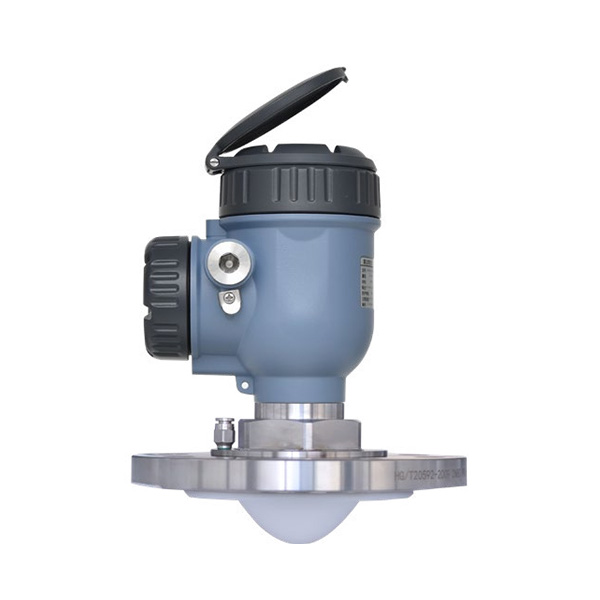
The beam angle defines how wide the radar signal spreads inside the vessel. A narrow beam radar level transmitter changes everything. Lower frequency devices typically spread their signal across 15 degrees or more. They hit vessel walls and internal hardware. An 80GHz device focuses its energy into a tight 3° to 8° cone. This concentrated beam easily bypasses internal structures. It drops straight down to the media surface without interference.
You should follow a strict checklist when evaluating beam angles:
Verify the exact internal dimensions of your tank.
Map out all internal geometries, including ladders and heating coils.
Calculate the beam spread at the bottom of the vessel.
Ensure the narrow beam cone avoids the mapped obstacles completely.
The dielectric constant (DK) indicates how well a material reflects radar signals. Water has a high DK value of around 80. It reflects radar energy perfectly. Hydrocarbons and dry powders have very low DK values. They absorb the signal rather than reflecting it back. You must check the minimum DK value your chosen meter can detect. This prevents weak return signals and lost measurements.
A good rule of thumb exists for low DK media. Materials like plastic pellets, fly ash, or light oils require high sensitivity. They demand advanced signal processing algorithms. You need a device explicitly rated for DK values below 1.5 if you handle these challenging materials.
Process environments vary wildly across a single facility. You must match the sensor housing and antenna material to your specific conditions. We often see buyers under-specifying materials to save money. This leads to rapid sensor failure. Conversely, over-specifying creates unnecessary budget strain. You need a balanced approach.
Consider the difference between PTFE and PEEK lens antennas. PTFE handles standard chemical applications exceptionally well. It resists corrosion effectively. However, it deforms under extreme temperatures and pressures. PEEK offers superior mechanical strength. You need PEEK antennas for high-pressure reactors. Always verify the maximum continuous operating temperature. Do not rely solely on peak burst ratings.
We can summarize the core technology comparison in the chart below:
Feature | Legacy 26GHz Radar | Modern 80GHz Radar |
|---|---|---|
Beam Angle | 10° to 20° (Wide spread) | 3° to 8° (Highly focused) |
Antenna Size | Large (Requires wide nozzles) | Small (Fits standard 1.5" nozzles) |
Condensation Resistance | Moderate to Low | Exceptionally High |
Dead Band (Blind Zone) | Typically 300mm+ | Virtually zero (measures up to lens) |
Different industries demand completely different measurement approaches. Standardizing on a single model across diverse sectors usually fails. You must tailor your tank level measurement strategy to the specific environmental hazards.
The water and wastewater sector presents unique challenges. Pump stations and digesters produce heavy condensation. Surface foam develops rapidly. You should focus heavily on moisture resistance here. Look for devices carrying true IP68 ratings. They must survive complete submersion during flooding events. The 80GHz frequency penetrates digester foam without signal degradation. You maintain accurate volume control even during aggressive aeration cycles.
The chemical and petrochemical sectors prioritize human safety above all else. Explosive atmospheres are common. Corrosive vapors attack exposed metals constantly. You must look for rigorous explosion-proof certifications. Ensure the device carries ATEX, IECEx, or local equivalent approvals. SIL2 or SIL3 compliance is mandatory for safety instrumented systems. Pay close attention to wetted parts. Specify encapsulated antennas to prevent chemical ingress. This protects the internal electronics from highly corrosive off-gassing.
Agriculture and bulk solids handling introduces extreme dust environments. Grain silos and cement bins generate thick airborne particulates during filling. This dust coats sensor faces quickly. You must address this buildup proactively. Specify devices with integrated air-purge connections. These allow you to blow compressed air across the lens periodically. Specialized aiming flanges are also necessary. They let you angle the sensor toward the silo discharge cone. This ensures you track the lowest point of the material effectively.
Hardware specifications mean nothing if the installation is flawed. Nozzle dimensions represent the most common installation pitfall. Even a narrow beam can suffer from heavy interference. If you mount the sensor in a nozzle that is too long or too narrow, the signal bounces off the nozzle walls. This creates a massive false echo right at the top of the vessel.
Follow these installation best practices closely:
Ensure the sensor antenna extends slightly past the nozzle opening.
If extension is impossible, select a nozzle diameter that accommodates the beam angle without touching the walls.
Clean the flange surface thoroughly before mounting to ensure an airtight seal.
Level the flange precisely. Improper flange alignment shoots the radar beam into the vessel wall instead of the product.
Calibration has evolved significantly. You no longer need to perform complex physical tuning. Modern devices utilize intuitive Bluetooth and app-based configuration. You can stand safely on the ground and configure a sensor located at the top of a silo. This keeps technicians out of hazardous zones.
A realistic setup process relies on built-in echo curve diagnostics. These visual tools show you exactly what the sensor "sees" inside the tank. You can map out false echoes easily. The software then suppresses these unwanted signals automatically.
We recommend establishing a baseline echo curve during empty-tank commissioning. Record this curve when the tank is completely clean and empty. Save it in your maintenance records. You can compare future echo curves against this baseline easily. It helps you identify new signal anomalies, like unexpected material buildup or damaged internal hardware.
Buyers often face a confusing marketplace. You must navigate the divide between low-tier and premium offerings carefully. Understanding what you actually get for premium investments clarifies the decision process. High-tier devices usually feature advanced proprietary echo-tracking algorithms. These algorithms distinguish between falling material and the actual product surface during rapid filling. Premium options also offer global field support and longer warranty periods. Cost-effective alternatives might provide raw measurement data but lack these sophisticated diagnostic tools.
Assessing regional brands offers an interesting avenue for optimization. High-tier Chinese brands supply the European and global markets successfully today. They combine advanced manufacturing with rigorous quality control. You can consider these brands viable if they carry verifiable CE and ATEX certifications. They must meet global electrical and safety standards. This dynamic allows you to achieve high performance without exhausting your operational budget.
You should benchmark specific models to establish a baseline. Introduce the SL903 radar level meter as a standard for evaluating mid-to-high tier options. When you look at models like the SL903, check for a balance of features. Look for a robust measurement range, such as up to 120 meters for tall silos. Verify it uses standard 80GHz FMCW (Frequency Modulated Continuous Wave) technology. Ensure it features a robust housing suitable for harsh climates.
Your next steps require actionable engagement with vendors. Do not rely on datasheets alone. Request trial units for your most difficult applications. Demand empirical case studies showing their technology working in your specific industry. Verify their supply chain and lead times. A great sensor is useless if it takes six months to arrive during a plant shutdown.
Buying an 80GHz radar isn't just about selecting the highest frequency available. It is about matching the beam angle, DK sensitivity, and physical housing to your exact process reality. You must understand your tank geometries and media properties deeply. Proper installation and baseline calibration matter just as much as the internal electronics.
We encourage buyers to take a proactive approach to procurement. Map out your most problematic measurement points today. Reach out to specialists with your specific tank dimensions and media types. Ask for a custom technical evaluation. Request detailed performance data on shortlisted models like the SL903. Your processes demand reliable data, and modern 80GHz technology delivers it when applied correctly.
A: An 80GHz model offers a much narrower beam angle, usually between 3 and 8 degrees. This prevents the signal from hitting tank walls. It provides higher accuracy and better resolution. The 80GHz antenna is also significantly smaller. It fits easily into tighter, existing mounting nozzles.
A: Yes, but it depends heavily on the foam's physical characteristics. Light, airy foam is easily penetrated by the 80GHz signal. Dense, wet foam might reflect the signal back from its surface instead of the liquid below. You must evaluate the specific dielectric properties of your foam.
A: Calibration involves shifting from complex physical tuning to simple software input. You connect via Bluetooth or a local display. You enter the empty tank depth and full tank height. The software then generates an echo curve. You use this to suppress any permanent false echoes.
A: Absolutely. You must strictly follow local regulatory jurisdictions. Measuring flammable or explosive chemicals requires intrinsically safe (Ex ia) or flameproof (Ex d) certifications. Verify that the transmitter carries authentic ATEX, IECEx, or equivalent approvals before installation.


